The Australian real estate market shows signs of slowing down, interest rates remain high, and global financial markets are volatile. However, for buyers with a clear plan, this could also be an opportunity to choose more carefully, negotiate better, and prepare for long-term steps.
The market is slowing down, but buyers’ opportunities have not disappeared
The Australian real estate market is undergoing an adjustment period. Auction clearance rates are falling, interest rate pressure remains, while recent economic indicators show that the labor market is displaying signs of weakening.
Meanwhile, international financial markets have also experienced significant volatility across stocks, gold, and exchange rates.
These signals may cause many buyers to become cautious. However, a slowing market does not mean all opportunities vanish.
On the contrary, when the market is no longer overheating, buyers may have more time to evaluate properties, compare prices, consider financial capacity, and access options better suited to their needs.
1. Weaker auction market: Do buyers have more room to negotiate?
The Australian auction market is showing clear signs of weakness.
According to Cotality (18/11), the final auction clearance rate for the week ending November 15, 2026 reached 41.3%, the second lowest since April 2020. This figure is significantly lower than the 63.1% recorded in the same period last year.
In the past week, there were 1,874 auctions, the highest since late June, but still 41.5% lower than the same week last year (3,204 auctions). However, an increased volume of auctions does not necessarily translate into a higher clearance rate.
The auction clearance rate across major cities also varied:
- Brisbane: 21.2%
- Sydney: 42.4%
- Melbourne: 47.8%

For buyers, a slower auction market can offer a key advantage: not all properties face the fierce competition seen during market peaks.
This opens up opportunities for buyers to research recent transaction prices, assess fair market value, and consider properties that were previously harder to access.
Nonetheless, a low clearance rate does not mean all properties will sell at bargain prices. Homes with prime locations, good quality, limited supply, or strong interest can still maintain high levels of competition.
Nationwide housing prices are also undergoing adjustment. Economists at the Commonwealth Bank of Australia (CBA) suggest that this peak-to-trough decline could be the largest in the nation’s monthly price series—around 14%—before stabilizing in the second half of 2027 (CBA, 3/11).
Meanwhile, regional areas continue to decline less than capital cities but are no longer immune. Regional home prices fell 2% in the three months to October, nearly double the 1.1% decline of the previous quarter. Capital cities fell 4.5% over the same period. Days on market lengthened in 40 of the 50 largest regional centers; regional Queensland dropped 2.7%. The regional market is also fragmented: Kalgoorlie–Boulder rose 3.4% in the quarter, while Busselton fell 4.1%. (Cotality Regional Market Update, 18/11)
Instead of waiting for an elusive market bottom, buyers can focus on finding properties priced appropriately for their budget, needs, and long-term holding capacity.
2. Slowing economy, high interest rates: What should buyers prepare?
The Australian labor market is showing trends that require monitoring.
According to the Australian Bureau of Statistics (ABS), the unemployment rate in October 2026 rose to nearly 5%, while employment dropped by approximately 44,000 jobs. Youth unemployment reached 11.3%. On the other hand, the Wage Price Index grew by 1.1% in Q3 and 3.5% year-on-year.
These numbers indicate the economy is facing various pressures. Soft labor figures increase the likelihood that the RBA may pause at its December 7–8 meeting to safeguard economic growth. RBA meeting minutes (17/11) show that November’s rate hike to 4.85% passed with a 6–3 vote. Three members favored holding rates steady out of concern the economy might slow faster than expected. CBA expects the RBA to keep rates on hold on December 8, and markets have largely dropped bets on a December rate hike while pricing in about an 80% chance of a rate cut by August 2027 (market pricing, not RBA forecast). (CBA, 17/11; MPA, 19/11)
The RBA must also balance controlling inflation against the risk of an economic slowdown.
The cash rate target currently stands at 4.85% following the early November decision. This continues to put pressure on household borrowing costs.
If you are considering buying a home, stress-testing mortgage repayments across various interest rate levels, building a financial buffer, and avoiding borrowing at your maximum capacity can help mitigate risks in the coming years.
A sound financial plan will help you purchase a home and maintain stability after the buy. In a market where buyers no longer need to race against rapid price inflation, spending time on financial preparation, research, and selection can become a valuable advantage.
3. Volatile global financial markets: Is there a rush to find an alternative asset?
Over the past week, international markets also saw notable swings.
Expectations regarding US monetary policy, US bond yields, and sentiment surrounding tech stocks continue to impact financial markets. The market is pricing in a very high probability (around 94–99% per CME FedWatch, depending on the time on Nov 20) that the Fed will raise interest rates by 0.25 percentage points at its meeting ending December 9. The Fed has not made a decision yet. US 10-year Treasury yields fluctuated around 5%. (CME FedWatch via Admiral Markets and USAGOLD; Kalshi via Capp Notes, 20/11)
In the US stock market, the Dow Jones and S&P 500 both closed over 10% below their peaks during the Nov 20 session, entering correction territory, while Nasdaq dropped more than 5% during the session. (CNBC, 20/11)
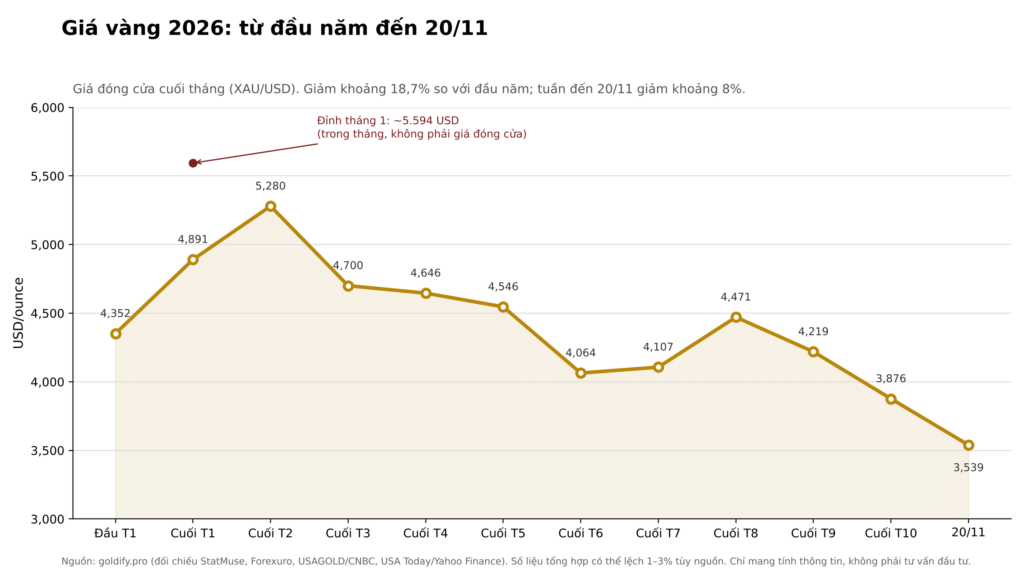
According to CNBC, gold prices fell about 8% in the week ending November 20, the sharpest drop in 8 months, driven by a strengthening US dollar and expectations of higher interest rates. Gold fell to around $3,500 to $3,600/oz, the lowest since September 4, 2025, and about 35–36% below its January 2026 peak (CNBC via USAGOLD; USA Today/Yahoo Finance, 20/11).
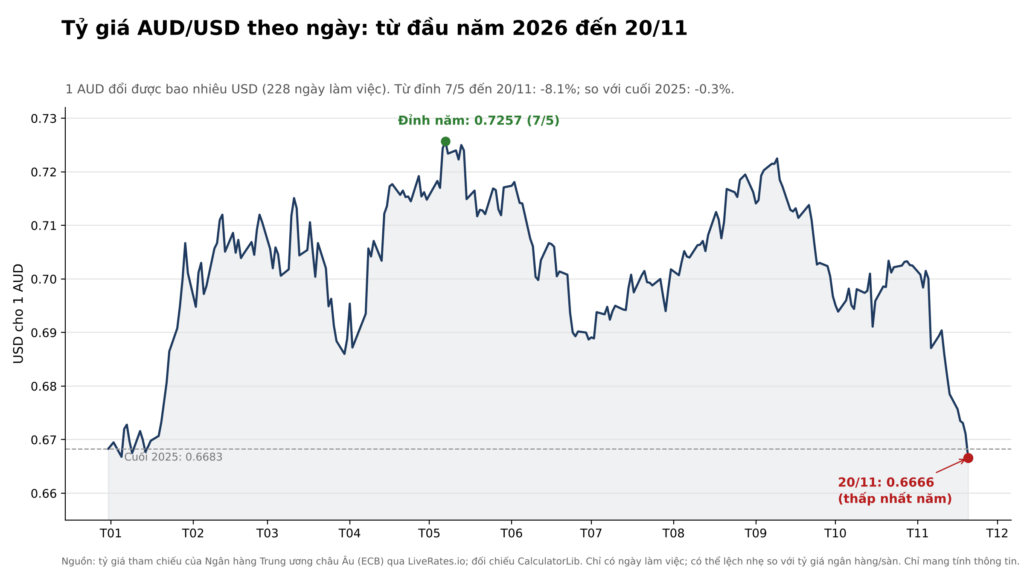
The AUD also weakened during the week, dropping below 0.67 USD.
While these shifts can affect investor sentiment, there is no simple rule stating that falling gold means real estate will rise, or that stock market volatility automatically makes residential housing a superior alternative.
Every asset class possesses unique characteristics regarding liquidity, price volatility, holding costs, and cash flow generation capability.
For prospective real estate buyers, the crucial question is not which asset will appreciate fastest in the short term.
Instead, consider:
- How long can you hold the property?
- Do borrowing costs and ownership expenses fit within your budget?
- Does the property fulfill your living needs or investment plans?
- Are you buying based on actual value or merely on price growth expectations?
A volatile market does not necessarily demand a rushed decision. It demands an informed decision.
4. For investors, cash flow and property value remain core factors
Amid shifting interest rates and property prices, rental yields remain a key metric for many investors.
According to figures in source documents, gross rental yields across Australian capital cities averaged around 3.77%, with Sydney at approximately 3.5%, Melbourne at 4.1%, Adelaide at 3.7%, and Perth at 4.2% (October 2026 data, Cotality via Canberra Times and Your Investment Property).
Rental performance also varies across sub-markets. National average asking rents rose 0.5% in the 30 days to November 12 and 6.4% year-on-year, slowing from 7.6% the previous month. Melbourne recorded a vacancy rate of 2%, the highest among capital cities, with rents declining for two consecutive months (SQM Research via Australian Broker, 17/11).
This indicates that the rental market is also fragmenting, meaning property selection should rely on local market data rather than national trends alone.
A property with a high gross rental yield does not guarantee positive cash flow. Investors must account for:
- Mortgage interest.
- Council rates, strata fees, and insurance.
- Property management fees.
- Maintenance costs.
- Vacancy periods.
- Taxes and associated expenses.
By analyzing these elements thoroughly, buyers can identify properties that align with their strategy instead of relying solely on expected price growth.
In a segmented market, finding the right property at the right price point and matching financial capacity can be far more critical than attempting to forecast overall market movements.
5. How can buyers leverage this period?
The current market is not suitable for every buyer, nor is there a universally perfect time to purchase a property.
However, if you plan to purchase a home within the next 6–12 months, this phase can serve as a valuable period for preparation.
First, evaluate real financial capability. Calculate repayments at current interest rates and test higher rate scenarios. Do not rely solely on the maximum borrowing limit offered by lenders.
Second, research actual transaction prices rather than relying on listing prices. Examine recently sold comparable properties, taking into account location, size, condition, property type, and neighborhood characteristics.
Third, take advantage of time to select more carefully. A slower market allows extra time for property inspections, neighborhood assessments, option comparisons, and reviewing contract terms.
Fourth, prepare thoroughly before participating in auctions or negotiations. Understand your budget boundaries, contract terms, deposit requirements, opening bids, and associated risks.
Fifth, do not hesitate to wait if you are not ready. If your income, job security, or finances are not yet stable, continuing to prepare is a sound decision. Home buying opportunities rely not just on immediate purchasing, but on being ready when a suitable option appears.
Conclusion: Opportunity lies not in predicting the market, but in preparing to choose wisely
The Australian real estate market faces key challenges: lower auction clearance rates, elevated interest rates, economic headwinds, and regional divergence.
However, this does not mean buyers must remain passive observers, nor does it mean rushing into a purchase simply because prices are adjusting.
A slower market provides more space for thorough research, negotiation, and decision-making. That opportunity is only meaningful when buyers understand their finances, properly evaluate properties, and follow a clear plan.
At Forward Real Estate (FRE), we believe sound buying decisions do not start with predicting whether prices will rise or fall. They begin with understanding the market, your needs, and your own capabilities.
If you are considering buying property in Australia, start by preparing rather than simply waiting for market shifts.
Note: This article is for general informational purposes only and does not constitute financial, investment, or legal advice.
 Vietnamese
 English